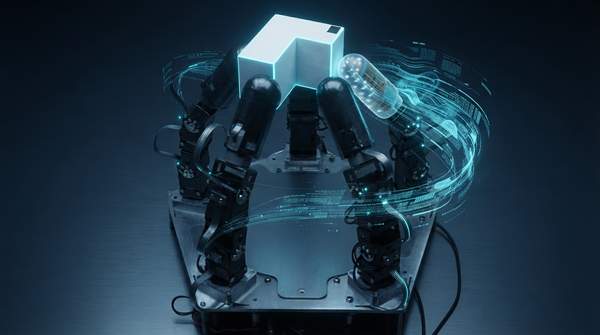
Reinforcement Learning from Human Feedback works the same way whether the student is a chatbot or a simulated robot arm: human preferences are collected, compressed into a learned reward model, and then used to optimize the agent's policy with an algorithm such as Proximal Policy Optimization. The technique became famous through ChatGPT, but the pattern predates and extends well beyond language. This article walks through the three-stage RLHF pipeline and shows how each stage changes when the task is a robot learning to move smoothly or an agent learning to play a game, where "correct" cannot be written down as a formula.
Beyond Language: Why RLHF for Robotics and Games?
Conventional reinforcement learning assumes you can write a reward function: a number the agent maximizes. That assumption collapses fast in embodied and open-ended domains. A robotics survey posted on arXiv notes that hand-crafted reward functions are typically task-specific and lack generalizability, limiting the scalability and broader applicability of conventional RL methods. The problem is not just difficulty but impossibility: qualities like a "natural" gait or a "fun" game-playing style resist mathematical definition, in the same way that a technical explainer by Nathan Lambert and colleagues at Hugging Face describes how writing a loss function to capture attributes like creativity or truthfulness "seems intractable."
RLHF sidesteps that roadblock. Rather than depending on explicitly specified reward functions, the arXiv robotics paper explains, RLHF leverages subjective human evaluations as learning signals, enabling policy optimization without intricate reward engineering. Instead of specifying what "smooth" means, you show a human two trajectories and ask which one is smoother. The judgment itself becomes the training signal.
The alternative—simple imitation learning, copying an expert action-for-action—has its own structural weakness: small deviations from the demonstrated behavior accumulate over time, a compounding-error problem. RLHF's shift from matching specific actions to satisfying expressed preferences is what lets it capture the intent behind behavior rather than just its surface, which is why IBM's technical overview reports that RLHF models have demonstrated impressive results training agents for complex tasks across robotics, video games, and natural language processing alike.
Stage 1: Initial Policy Training for Non-Language Agents
Every RLHF pipeline documented by the Hugging Face team begins with a base model: a language model pretrained with classical objectives before any human feedback enters the picture. For non-language agents, the analogous first stage is establishing a foundational policy—an agent that can already attempt the task at a basic level before anyone judges its style. The initial policy for a simulated walking robot might come from standard reinforcement learning against a simple, coarse reward, or from imitating recorded demonstrations; a game agent might start from a policy trained to survive rather than to play well.
This generalization from "pretrained LM" to "initial agent policy" rests on the structural similarity of the pipeline across domains: something must exist that can produce behavior worth evaluating before humans can rank it. A robot that cannot take a step generates no locomotion trajectories to compare, just as a chatbot that cannot produce text generates no answers to rate. The initial policy does not need to be good in any human sense—it needs to be diverse and functional enough that meaningful preferences can be expressed about its outputs.