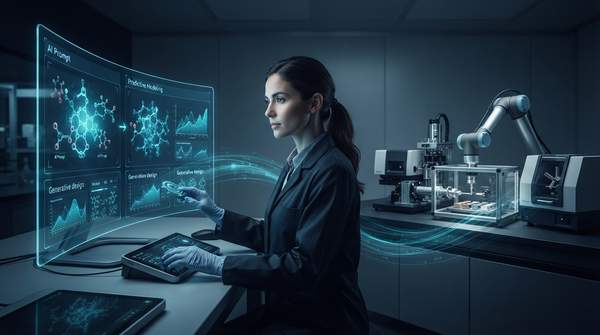
Artificial intelligence is increasingly integrated into scientific discovery to augment and accelerate research, and a 2023 review in Nature by Hanchen Wang and colleagues frames that acceleration precisely: AI helps scientists generate hypotheses, design experiments, and collect and interpret large datasets, yielding insights that "might not have been possible using traditional scientific methods alone." The useful way to understand this shift is not as a single technology but as a loop. AI intervenes at three distinct stages of the scientific method, and each intervention compresses the time and effort between an open question and a validated answer.
The AI-Accelerated Scientific Discovery Cycle
The traditional scientific method moves in one direction: a researcher forms a hypothesis, designs a test, gathers data, and interprets the results. AI turns that sequence into an iterative loop. Concepts generated by AI systems are evaluated and refined through experimental observation, expert input, and scientific tools, which then drive further iterations of the discovery cycle, as described in a survey paper on generative AI and scientific discovery. The loop matters because each turn is cheaper and faster than before. A hypothesis that once took months of literature review can be suggested from patterns in large datasets; an experiment that once required laborious manual design can be specified and optimized computationally; results that would overwhelm a human analyst can be processed at scale. The acceleration is cumulative across the cycle, not confined to any one step.
Stage 1: AI-Enhanced Hypothesis Generation
The first stage is where new ideas enter the pipeline. Rather than starting from a single researcher's intuition, AI systems can identify patterns and relationships across vast datasets, surfacing candidate hypotheses a human might never encounter. The physicists' perspective is instructive: Mario Krenn, who develops AI algorithms at the Max Planck Institute for the Science of Light, has described AI as "a muse — a source of inspiration and ideas for scientists," with algorithms that help his team learn new concepts in physics. In biomedicine, the mechanism is more concrete.
Biomni, an AI agent developed at Stanford, pulls together hundreds of specialized tools, databases, and software packages into a unified research environment. With reasoning capabilities and the ability to write Python code, the agent can generate a new hypothesis without predefined templates or task-specific tuning. Jure Leskovec, professor of computer science at Stanford, calls it "a true collaborator." The acceleration here is breadth: the system can survey far more of the existing knowledge landscape than a human reader.