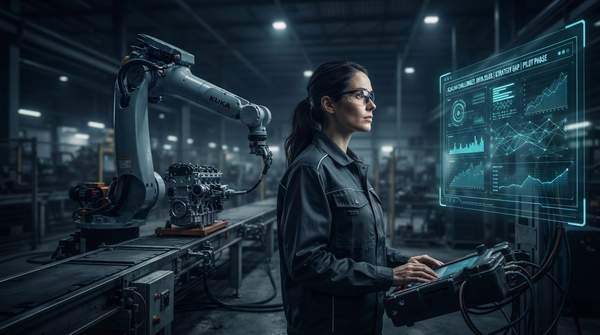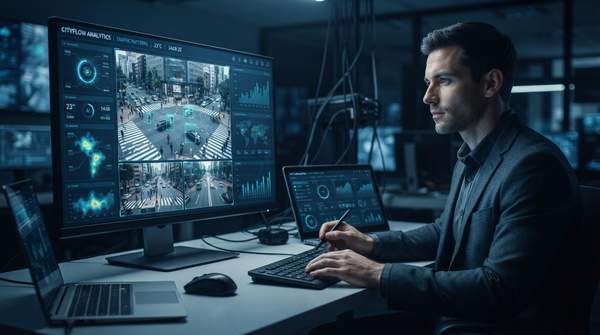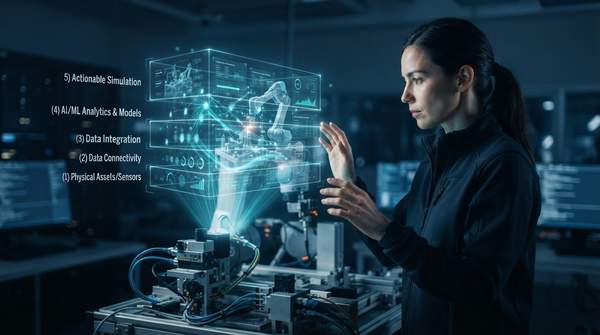
An industrial AI digital twin is not a single piece of software but a stack of functional layers, each of which must be present and integrated for the platform to deliver outcomes like predictive maintenance or process optimization. The Digital Twin Consortium's industrial applications white paper, developed with the Industrial Internet Consortium (IIC), describes twins that combine physics and engineering models, statistical and machine learning models, and 3-D and augmented reality representations to describe, understand, predict, and prescribe the behavior of real-world assets. Understanding that stack—physical asset, data acquisition, semantic modeling, virtual modeling with AI, and application delivery—is what allows an engineering or business reader to work backward from a target outcome to the components it actually requires.
Understanding Industrial AI Digital Twin Architecture
What separates a digital twin from a static CAD model or a traditional simulation is a persistent connection to the physical asset, according to Cloudera's data management guidance. That connection is what makes the architecture layered rather than monolithic: raw signals originate at the asset, travel through acquisition and contextualization stages, feed computational models, and finally surface as decisions delivered to people and enterprise systems. The IIC's model of twin "models" spans physics- and chemistry-based representations, engineering and simulation models, and data-driven models built on statistics, machine learning, and AI, along with 3-D and augmented reality models that aid human understanding of operational states. Each of these model families lives at a different point in the stack and depends on the layers beneath it functioning correctly.
Layer 1: Physical Layer – The Foundation of Data
Everything begins with the physical asset itself: the pump, conveyor, turbine, or production cell, together with the sensors embedded in it. The quality of every downstream insight is bounded by what this layer can actually measure, because a twin can only describe, understand, and predict states for which it receives corresponding telemetry. Cloudera's guidance on creating a twin for an existing asset makes the dependency explicit: creation begins with defining the data model and identifying the key telemetry needed from the physical asset. In other words, the physical layer is not merely where data comes from; it is where the requirements for the entire twin are first specified, since the choice of measured variables determines which failure modes, energy flows, or process behaviors the twin can ever represent.