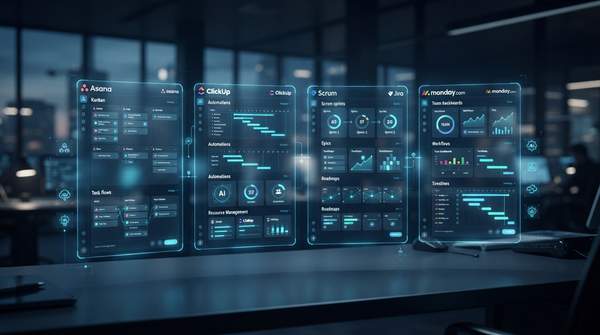
There is no single best AI project management tool for agile teams — the right choice depends on your team's operational focus. Third-party product analyses reviewed in October 2026 point to a clear pattern: Asana AI suits cross-functional teams whose work lives outside a developer's issue tracker; ClickUp suits teams consolidating docs, tasks, and chat into one workspace; Jira suits technical teams doing engineering work; and monday.com suits teams new to structured project management that want an approachable, visual system. This comparison is drawn from publicly documented features and independent product analyses, not hands-on benchmarking of the underlying AI.
Introduction to AI in Agile Project Management
AI in project management promises three things that matter to agile teams: intelligent prioritization of work, better resource allocation, and predictive risk detection before a sprint derails. The tools differ in which of these they actually deliver and for whom. Asana AI, for instance, predicts risk areas in projects, recommends deadlines based on past performance, and suggests priority tasks for upcoming sprints — features that help spot sprint blockers before they derail the plan, according to a Bito comparison of AI sprint-planning tools published in May 2026.
But feature lists alone are a poor basis for a decision. Writing on project management AI for Celoxis, Mahua Das argues that AI is only as good as the data it consumes, and that many tools struggle with unstructured or siloed data, producing skewed insights or missed signals. Scaled Agile's Lindsey Bohland, in an article on AI versus traditional methods published in March 2026, makes a complementary point: AI works best when combined with human judgment, experience, and contextual awareness, and poor data inputs can lead to unreliable forecasts or unrealistic timelines. The practical implication is that tool selection and data readiness must be evaluated together.
With that framing, the four platforms below are the strongest documented candidates for agile teams seeking AI capabilities. Pricing is deliberately excluded, since it changes frequently and the sources' pricing details may not reflect current plans.
AI Project Management Tools for Agile Teams: A Comparative Matrix
The table below categorizes the four tools by their ideal user profile, standout AI capabilities, primary advantages, and limitations reported by the product analyses. Agiflow's October 2026 comparison, which reviewed the tools for agent access and shared project context, supplies the fit and watch-out columns for several rows; the AI feature details come from Bito and Ben Brigden's Teamwork.com review from May 2026. Use it to shortlist the one or two tools that match your team's structure before evaluating further.
| Tool | Best Fit For (Team Type) | Key AI-Powered Feature | Primary Advantage | Key Limitation (Watch For) |
|---|---|---|---|---|
| Asana | Cross-functional teams running product, marketing, and engineering work in one place; teams already working in Asana | Predictive work management: risk-area prediction, deadline recommendations based on past performance, priority-task suggestions for sprints; automated status reporting that drafts stakeholder summaries from task progress, milestones, and blockers | Clear accountability and project tracking; workflows, goals, and collaboration with AI layered into a broader work platform | Can be more platform than a small team needs; a separate tool from Jira, so pure-Jira teams gain little overlap coverage |
| ClickUp | Agile and scaling teams that want one workspace for docs, tasks, chat, and AI | Workspace AI for summarizing and querying work | Broad feature coverage, supporting consolidation of project tracking, documents, and time tracking | Setup and governance can become work of their own |
| Jira | Technical teams managing issues and engineering work | Issue tracking, sprint work, and software team structure — its strengths center on technical project management rather than assistant-driven workflows | Purpose-built for software development | Often too technical for non-engineering teams; ease of use rated moderate-to-complex |
| monday.com | Teams new to structured project management | Automation and AI assistance that simplify common project management tasks | Approachable, visual workflows and customization; rated easy to use | Less focused on AI-assistant-driven workflows |
Two notes on reading the matrix. First, these are practical assessments from product analyses, not formal benchmark scores — the ease-of-use ratings come from Recited AI's October 2026 comparison, which explicitly labels them as such. Second, the rows reflect what each analysis documented at review time, so verify current capabilities against vendor documentation before committing.