
Meera Iyer
Editorial byline
Meera Iyer is an editorial byline for The Bot Shelf, with a focus on Creative AI, Consumer Tech, Explainers. Biographical credentials and external profiles are published only after verification.
Learn more about our editorial process and use of automation in our AI & Automation disclosure.
Coverage Areas
Latest Articles

How Sora-Style Models Turn a Text Prompt Into Coherent Video
Modern text-to-video models like OpenAI's Sora generate video by first compressing it into "spacetime patches." A transformer then iteratively denoises these patches, guided by the text prompt, to produce coherent and temporally consistent clips.
Oct 30, 2026 · 5 min read

Choosing Between Single-Agent, Vertical, and Collaborative Agentic AI Architectures
Agentic AI architectures vary, and the optimal choice—single-agent, vertical multi-agent, or collaborative multi-agent—depends on the task's complexity and interdependency. This guide compares these patterns and their alignment with essential enterprise platform layers like orchestration and observability.
Oct 27, 2026 · 5 min read

Local vs. Cloud: How Amazon's Bee and the Friend Wearable Split on Your Conversation Data
The primary distinction between Amazon's Bee and Friend wearables is their data processing architecture: Bee processes conversations locally on-device with no audio storage, whereas Friend utilizes cloud-based processing involving third-party AI services. This difference has significant implications for user privacy, particularly in sensitive environments.
Oct 26, 2026 · 4 min read

How AI Turns Brain Signals Into Device Commands: The Four-Stage BCI Pipeline
This article details the four-stage AI pipeline that transforms raw brain signals into actionable device commands for Brain-Computer Interfaces (BCIs). It explains how AI is crucial for signal acquisition, preprocessing, decoding user intent, and actuating external devices.
Oct 25, 2026 · 5 min read
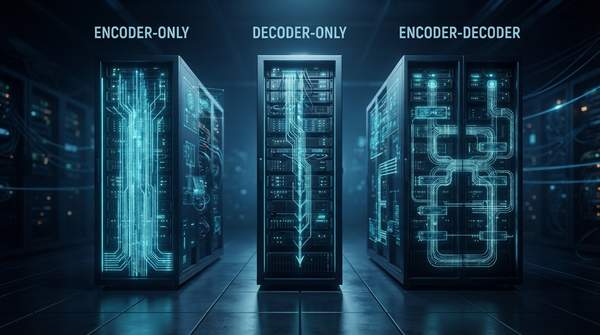
Three Architectural Patterns: How Transformers Power Far More Than Language Models
The Transformer architecture has evolved into three core patterns—encoder-only, decoder-only, and encoder-decoder—each suited for distinct tasks like understanding, generation, or sequence transformation. These versatile patterns extend beyond language models, finding applications in computer vision and other domains.
Oct 24, 2026 · 5 min read

Why Banks Are Blocking AI Agents — and Which Architectures Create the Risk
Banks are blocking AI agents due to architectural security risks, as agents take actions rather than just producing outputs. The inability to distinguish AI actors from human users via compromised credentials necessitates a shift towards agent-specific authorization and robust governance frameworks.
Oct 23, 2026 · 6 min read

What Are AI Agents? How Autonomy Separates Them From Bots and Assistants
AI agents are autonomous software systems that perceive, reason, and act to achieve goals independently, distinguishing them from simpler bots and assistants. Their core architecture and functional loop enable them to perform complex, multi-step tasks proactively and adaptively.
Oct 22, 2026 · 5 min read

Samsung vs. LG Smart Home AI: On-Device Privacy Meets Open Ecosystems
This article compares Samsung's SmartThings and LG's ThinQ smart home AI strategies, focusing on their differing approaches to on-device processing, privacy, and ecosystem openness. It helps consumers understand the trade-offs between Samsung's privacy-centric, integrated model and LG's adaptive, context-aware intelligence.
Oct 20, 2026 · 5 min read

How AI Enhances Learning: Personalization, Feedback, and Teacher Support—Plus the Risks to Weigh
Artificial intelligence enhances education by personalizing learning, providing instant feedback, and supporting teachers, but its integration requires careful consideration of ethical risks such as data privacy and algorithmic bias.
Oct 18, 2026 · 5 min read

AI-Generated Art: A Guide to U.S. Copyright Law and Ethical Use
This guide examines the U.S. Copyright Office's stance on AI-generated art, emphasizing the necessity of human authorship for copyright protection, and explores the broader ethical landscape beyond legal frameworks.
Oct 9, 2026 · 5 min read

Navigating AI Agents: Comparing Privacy and Control in DoorDash and Robinhood
Consumer AI agents offer convenience but raise privacy and control concerns. This article compares DoorDash's and Robinhood's approaches, providing a framework for evaluating agent design and user agency.
Oct 1, 2026 · 4 min read

Meta Expands Muse AI to Small Businesses, Signaling Major Enterprise Pivot
Meta is expanding its AI agent, Muse, to small businesses, marking a significant pivot into the enterprise market. This new offering integrates with numerous business tools to help owners manage operations and find new customers.
Sep 30, 2026 · 4 min read

What Are Attention Mechanisms and Why Do They Power Transformers?
A single Transformer model, built exclusively on attention mechanisms, achieved a 41.
Sep 20, 2026 · 5 min read

What Are Diffusion Models and How Do They Generate Images?
Concerns about data privacy, security, and artistic ethics have emerged with the extensive deployment of diffusion models in image generation, according to opportunities and challenges of diffusion mo
Aug 25, 2026 · 4 min read

How Reinforcement Learning From Human Feedback (RLHF) Shapes AI
Large language models like ChatGPT owe their remarkable ability to understand and respond to human prompts directly to Reinforcement Learning from Human Feedback (RLHF).
Aug 21, 2026 · 4 min read

What is Interpretable AI and Why Do Trustworthy Systems Matter?
Opaque AI technologies already raise serious patient safety concerns.
Aug 19, 2026 · 4 min read

What Is Embodied AI's Role in Future Robotics?
By 2025, the UBTech Walker S1 robot will be adjusting its posture and grip in real-time on Chinese car assembly lines, handling diverse components with a dexterity once thought impossible for...
Jul 21, 2026 · 4 min read

What are multi-agent systems and why do they matter for AI?
The cost of running advanced AI models has plummeted by over 90% since 2023.
Jul 14, 2026 · 5 min read

Positional Encoding for LLMs: Challenges and ADAT's Solution
A novel Adaptive Transformer (ADAT) architecture has demonstrated superior translation accuracy and faster training times on complex datasets like MedASL, offering a clearer window into nuanced commun
Jul 7, 2026 · 5 min read

What is Agentic AI? Its Core Components and Capabilities Explained
In complex healthcare workflows, Agentic AI architectures, supported by high-speed and low-latency 6G communication, are poised to enable efficient autonomous decision-making and coordinated task exec
Jul 4, 2026 · 4 min read